Comparison
Taxi Advertising vs Billboards
One big sign that never moves, or many small signs that never stop. Here is the honest cost, reach and memory comparison between billboards and taxi advertising, with the same recall math applied to both.
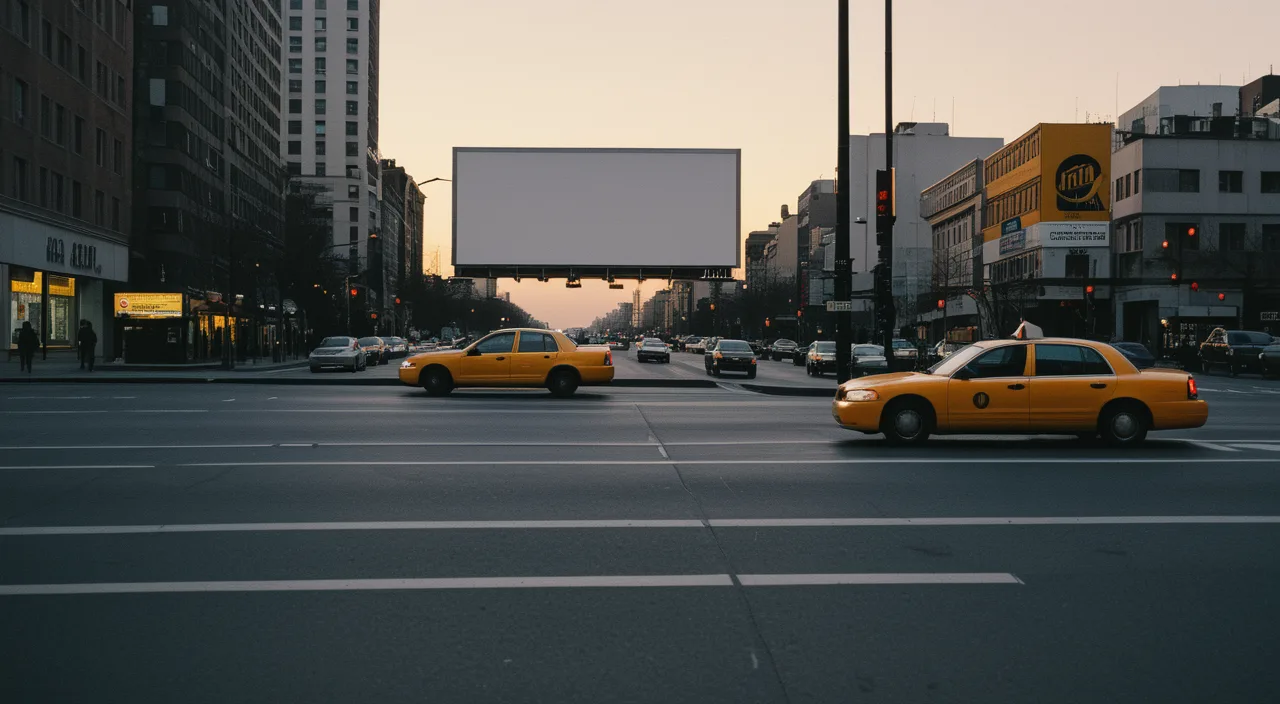
Taxi advertising and billboards are the two formats most local advertisers compare, and the sticker prices point in opposite directions. A digital taxi top costs roughly $200 to $400 per cab for four weeks (DASH TWO), while a static highway bulletin runs about $1,000 to $10,000 for the same period in major markets, with small-market boards starting near $500 (DASH TWO, AdQuick). Billboard CPMs typically land between $3 and $10 (AdQuick). The cheaper-looking option depends entirely on what you count: one big sign in one place, or many small signs that move.
This comparison runs both formats through the same honest framework this site applies to everything: real cost, real reach, and cost-per-memory rather than the impression line. The numbers are industry ranges, not quotes, and both formats are subject to the same brutal attention math.
What each format costs
| Format | Typical cost / 4 weeks | Structure |
|---|---|---|
| Static taxi top | $150–$300 per cab | Multiply by fleet size; fleet discounts 15–25%. |
| Digital taxi top | $200–$400 per cab | Rotating creative, dayparting. |
| Static bulletin (14'×48') | $1,000–$10,000 | One location; small markets from ~$500. |
| Digital billboard | $1,200–$15,000 / month | Slot rotation; runs 30–50% above static. |
Sources: DASH TWO and AdQuick pricing guides, industry estimates. The structural difference matters more than the totals. A billboard is one decision about one corner of the city. A taxi budget is divisible: ten cabs, twenty cabs, a different mix of formats, scaled up or down mid-year. Divisibility is a real financial feature, you can test small and scale what works.
One place versus everywhere: the reach pattern
A billboard buys depth in one location. The same commuters pass it daily, which builds frequency against a fixed audience: strong for directional messages ("exit 12") and for owning a high-traffic corridor. The audience is capped at whoever passes that point, and a bad location is a bad campaign for the full term of the contract.
A taxi buys breadth across a city. A working cab covers 100+ miles a day through commercial, residential, airport and entertainment districts, by industry estimates, reaching different people in different neighbourhoods rather than the same people repeatedly. That pattern favours general brand awareness over directional messages, and it hedges location risk: no single bad corner can sink the buy. The taxi top guide covers the format in detail.
The attention math is the same, and it is brutal for both
Both formats sell impressions, and impressions are opportunities to see, not memories. The out-of-home funnel applies to a parked sign just as it applies to a moving cab: only 30 to 50% of passers can actually see an ad, a fraction consciously process it, and roughly 0.4 to 2% remember the brand (Geopath, Digital Signage Today). Creative quality swings cost-per-memory by up to 5x in either format.
So neither side of this comparison escapes the math, and the vendor who quotes you "400,000 monthly impressions" for a board owes you the same honesty as the one quoting 100,000 for a cab. Divide the real budget by the realistic memory count, 0.4 to 2% of impressions, and compare formats on that number. It is the only line on the worksheet that predicts whether anyone calls you. The full walkthrough is in does taxi advertising actually work.
When the billboard wins
Choose the board when the message is directional and the location is genuinely strategic: a highway exit before your store, the one corridor your whole market drives, a landmark position your brand can own for a year. Frequency against the same commuters compounds, and a 14-by-48 bulletin delivers a scale of presence a cab roof cannot. Billboard CPMs of $3 to $10 (AdQuick) are also among the lowest in advertising, if raw exposure tonnage is what the campaign needs.
When the taxi wins
Choose cabs when the audience is spread across a metro rather than one corridor, when budget needs to start small and scale on evidence, and when street-level eye contact matters: a taxi top rides at pedestrian height in dense districts where billboards are scarce or banned. The interior formats add something the billboard structurally cannot offer, a seated, captive viewer with minutes of dwell time instead of a glance, covered in the Taxi TV guide. And in city cores like New York, taxi media reaches the pedestrian density that highway bulletins never touch, with its own rules and rates.
The honest verdict
It is not taxi versus billboard, it is fixed-deep versus mobile-broad, and the right answer follows your customer map. Directional, corridor-bound, long-term presence: the board. Metro-wide awareness, divisible budget, street-level and in-car attention: the cabs. Either way, refuse to buy on the impression line. Run your actual budget through the Cost & Real-Reach Estimator, apply the same 0.4 to 2% recall discount to the billboard quote, and let cost-per-memory pick the format.
Frequently asked questions
Is taxi advertising cheaper than a billboard?
What is the CPM of a billboard versus a taxi ad?
Do billboards or taxi ads get more attention?
When is a billboard better than taxi advertising?
When is taxi advertising better than a billboard?
Figures on this page are industry estimates and vary by market and vendor. Prices and reach are directional, not quotes. Every claim links to its source; see all sources.