Cities
New York Taxi Advertising
The biggest taxi audience in America, the highest rates, and the only US market where the regulator shapes your budget. Here is what NYC taxi advertising really costs, the TLC rules you cannot skip, and what a Manhattan cab actually earns you in memory.
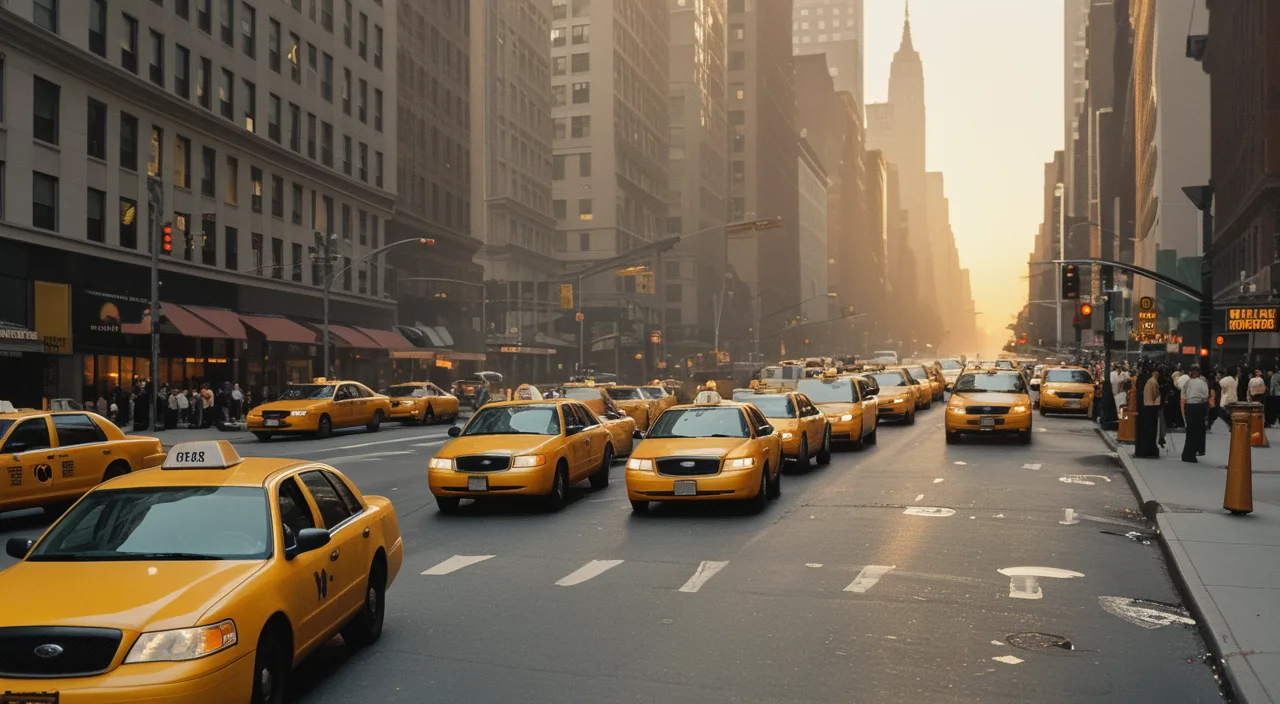
New York taxi advertising costs more than any other US market and regulates harder than all of them, and you should plan for both from day one. Static taxi tops price at the top of the $150 to $300 range per cab for four weeks, digital tops at the top of $200 to $400, and full wraps run $500 to $2,000 or more (DASH TWO). Interior screens are sold by TLC-licensed providers on a CPM basis of roughly $15 to $30 (Digiday). On top of the media, New York adds permit and licensing costs that most cities never charge.
That is the short version. The longer version is what this page is for: the real prices, the Taxi and Limousine Commission rules that can void a campaign, what a Manhattan cab actually delivers in memory rather than impressions, and whether the New York premium is worth it for your budget. For how NYC compares with other markets, start at the city-by-city guide.
How much does taxi advertising cost in New York?
New York prices sit at the upper end of every national range because more advertisers compete for a finite fleet than anywhere else in the country. A transit ad in NYC averages about $29.19 CPM (BillboardsIn), a useful benchmark when you compare cabs against subway or bus inventory in the same city.
| Format | NYC cost, per cab, 4 weeks | Note |
|---|---|---|
| Static taxi top | $150–$300, top of range | Plus TLC-approved device and permit overhead. |
| Digital taxi top | $200–$400, top of range | Lit at night; rotating creative. |
| Full wrap | $500–$2,000+ | Production billed separately; can push totals past $3,000. |
| Interior / rideshare screens | CPM $15–$30 | Sold by TLC-licensed providers, not per cab. |
All figures are industry ranges (DASH TWO, Digiday), not quotes; New York campaigns should be budgeted from the high end. The full national breakdown by format lives on the taxi advertising cost guide, and the Cost & Real-Reach Estimator applies the New York multiplier for you.
The TLC rules that shape every NYC campaign
New York is the only major US market where regulation is a first-order budget line. The Taxi and Limousine Commission controls what can be mounted on a yellow cab and who may sell advertising inside one, and ignoring either rule does not produce a fine-print problem, it produces a removed campaign.
Rooftop ads: Rule 58-34
Rooftop advertising on a New York yellow cab is only permitted on a TLC-approved device. The medallion owner must hold a paid annual advertising permit, and the ad itself is restricted to the two sides of the rooftop unit, not the front or back, and generally cannot extend beyond the unit's surface (NYC TLC, Rule 58-34). An unauthorized fixture risks a summons, which means your creative comes down mid-flight and the spend is wasted.
As an advertiser you will not file this paperwork yourself, the media owner does, but the compliance cost is baked into the New York rate you are quoted. It is one reason the same physical taxi top costs more in NYC than in Chicago.
Interior screens: the $1,500 FHV license
Selling advertising on screens inside for-hire vehicles requires an FHV Interior Advertising Provider License, which costs $1,500 for three years and requires TLC-approved tablets and software (NYC TLC). The practical effect is a short list of legal sellers. T-Mobile's Octopus network is the authorized provider on the rideshare side (T-Mobile), so NYC interior inventory is bought through licensed networks, never from individual drivers.
What does a New York cab actually reach?
A cab in a dense market like New York generates 100,000 or more impressions a month, roughly 3,300 a day, by industry estimates. The number is real, and it is also the number that misleads most first-time buyers. An impression is an opportunity to see, not a memory. Independent funnel data shows that only 30 to 50% of passers can actually see a moving ad, a fraction of those consciously process it, and just 0.4 to 2% walk away remembering the brand (Geopath, Digital Signage Today).
Run the honest math on one NYC cab for a month: 100,000 impressions become roughly 400 to 2,000 actual brand memories. At a $300 four-week rate, that is a cost-per-memory between about 15 cents and 75 cents, and good creative versus weak creative swings that figure by up to 5x (Digital Signage Today). This is the comparison that matters, and it is the one vendors skip. The full walkthrough is in does taxi advertising actually work.
Exterior or interior in New York?
The exterior-versus-interior split matters more in New York than almost anywhere, because the city offers extremes of both. Exterior formats, taxi tops and wraps, ride the densest pedestrian traffic in the country: broad reach, shallow attention, brutal clutter. Midtown sidewalks put more eyes on your cab per hour than any other US street, and more competing signage around it than any other US street.
Interior is the opposite buy. New York is a live market for Octopus, the T-Mobile rideshare tablet network that reaches about 2 million unique riders a month nationally at a $15 to $30 CPM, with sensor-based verification that only counts a rider who is actually present (Digiday, T-Mobile). Uber's JourneyTV program extends the same captive-rider logic across 50,000+ vehicles nationally (Uber). A seated rider on the FDR with twelve minutes of dwell time is a fundamentally different audience from a pedestrian glancing at a passing top. The rideshare advertising guide covers how that inventory is bought.
Who sells taxi advertising in New York?
NYC taxi and rideshare media is sold by networks, not drivers. On the exterior side, Firefly operates digital car-top inventory across major US markets including New York, having absorbed the legacy operators Strong Outdoor and Curb Taxi Media (Firefly). On the interior side, the TLC licensing regime funnels inventory through approved providers, with T-Mobile's Octopus as the authorized rideshare tablet network (NYC TLC, T-Mobile). Expect to deal with a media owner or an out-of-home agency, expect a rate card quoted per cab per four weeks for exterior and per CPM for interior, and expect New York to sit at the top of both.
Is the New York premium worth it?
It depends entirely on where your customers are, which sounds evasive and is actually the whole answer. For a national brand that needs the densest possible urban audience, New York's scale justifies the premium: no other US market concentrates this many people, this many hours a day, around moving media. For a regional advertiser whose buyers live in New Jersey or Westchester, a Manhattan-weighted campaign pays New York rates to be remembered by tourists.
The honest decision process is the same one this site applies everywhere. Ignore the impression count, estimate the real reach, divide the cost by memories rather than passes, and compare that figure against other cities before you sign. The estimator does the arithmetic in thirty seconds, and it will tell you honestly when a cheaper market beats the famous one.
Frequently asked questions
How much does taxi advertising cost in New York?
Do you need a permit for taxi advertising in NYC?
What is the FHV Interior Advertising Provider License?
How many people see a taxi ad in New York?
Is New York the best city for taxi advertising?
Figures on this page are industry estimates and vary by market and vendor. Prices and reach are directional, not quotes. Every claim links to its source; see all sources.